
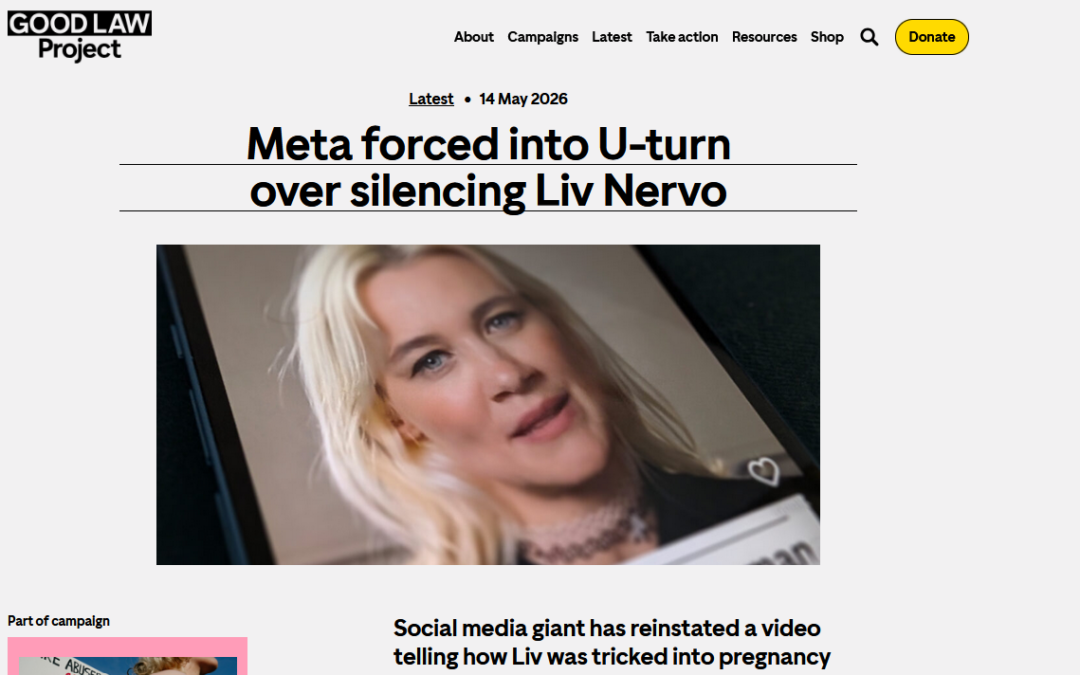
The Good Law Project reported last month that Meta (the company that owns Instagram and Facebook) removed a post about their campaign supporting Liv Nervo – Liv Nervo told her story – but Meta took it down (8 April).
The original proceedings were about contact and financial support for the daughter of Ms Nervo and Mr Pringle. [CLARIFICATION (1 June 2026) However, Ms Nervo didn’t make any applications to court on financial matters. Issues about financial support were referred to in the judgments only in relation to out-of-court negotiations which, the mother’s lawyers submitted, included threats by the father to make child support contributions contingent on the mother signing non-disclosure agreements and stopping publication of certain reports. The father’s original applications were for parental responsibility and a child arrangements order for contact – the mother’s lawyers argued that these applications were made to exploit the privacy protection of the family court rather than out of genuine interest in his daughter (RC v FP (no. 2: Costs) [2025] EWFC 124 Paras 40; 66).]
We wrote about the Pringle v Nervo case on 24 March – ‘When transparency orders create opacity’. Our interest was mainly the result of the father’s appeal against a costs order that meant he was no longer anonymised under a Transparency Order (TO) that had previously hidden his identity in any official or media reports from the lower courts. The TO in place said that the child’s parents should not be named in connection with the family court proceedings before the child turns 18 – the aim was to protect the child from attention, but it had also meant that the parents weren’t identified. In that March post, we explained this unusual turn of events when Mr Pringle appealed.
Ms Nervo had for some time wanted to publicise the way the case had gone, as part of her wider story. In the Family Court judgment that extended the TO until the child was 18, RC v EP [2025] EWFC 123, the judge pointed out that the mother wanted to discuss what had happened in proceedings because she:
… complains about the injustices she feels she has suffered in the court process. She feels “let down by the family court” … I know she was unhappy with my judgment of 16th September 2024. She feels she has nothing to show for two years in court proceedings and over £500,000 in costs. However, this does not in my view add much weight to this argument [for publicity] not least because one party often feels “let down” by the court … [74]
The judge discussed the father’s ‘fear of publicity’ and the continuing impact that further media coverage would have on him and his family. The decision to extend the TO was however based on the child’s rights to privacy, and to minimise conflict in the child’s interests, rather than to protect the father.
We should point out that, so far as we are aware, the child herself is still not named or pictured in the public domain as connected with this case. The TO has not been discharged as far as we know, and presumably still prohibits the identification of the child as a subject of the original proceedings.
Ms Nervo and the GLP argue that this is a case of reproductive coercion because she was tricked by him into becoming pregnant. The Court of Appeal acknowledged:
the father’s shameful and deceitful behaviour towards the mother … his admission that that behaviour amounted to the emotional abuse of the mother. It is clear that the father’s behaviour, quite understandably, remains a source of considerable bitterness and continuing distress to the mother [66]
Facebook coverage of the case
When we publish a new blog post we customarily post a link and a short comment on Bluesky and on our Facebook page. We linked to this story on 24 March. This is what our post still looks like on Facebook –
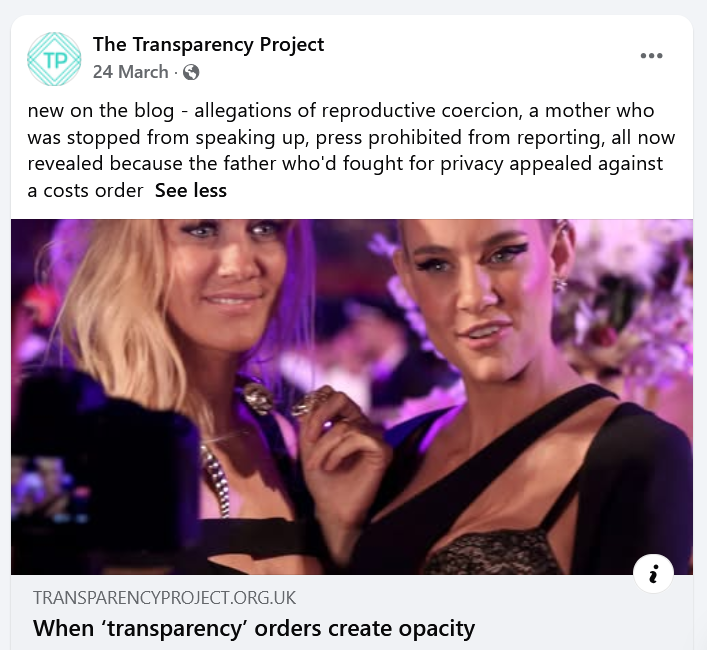
We were concerned to hear that the GLP’s posts on Instagram and Facebook about the case had been removed by Meta. Ours hadn’t been interfered with, to our knowledge. This is probably because the GLP have many more followers than we do.
The GLP said they were complaining to Meta. They suspected that Mr Pringle had asked Meta to remove the post. We don’t know what the basis would have been, because we didn’t see the GLP say anything on Facebook that wasn’t public knowledge.
As we noted in our April Roundup, there was also a piece in the Guardian – ‘Labels protect us’: Olivia Nervo wants reproductive coercion to be a standalone offence – she is not alone’, published on 18 April. [AMENDMENT (1 June 2026) We have been asked to add some context to the term reproductive coercion. Research by Spearman, Ayeb-Karlsson et al is referred to in The Guardian and can be read here – A Theoretical Model of Reproductive Coercion and Abuse and Legal Entrapment: Barriers to Health, Safety, and Well-being for Mothers and Children. We understand that posts by Professor Ayeb-Karlsson about this case on Facebook and Instagram were also removed by Meta in April but have since been reinstated.]
Outcome
The GLP have now reported: ‘Meta forced into U-turn over silencing Liv Nervo’. In their new video they say they have won a battle to ‘make Meta do a massive U-turn’. They say their posts have been reinstated:
Pringle’s disgraceful conduct had already been brought into the light. And it’s a vital case study in the fight to get justice for women all over the world who have been deceived into having a child. Meta should never have taken the video down – and now they’ve admitted they were wrong.
Meta told the Guardian, “This content was initially restricted in the UK following a request for removal received through our reporting tools. Following further legal review, we have determined the restriction was not required and the content is now accessible in the UK.”
We’re not sure why the GLP is quoting The Guardian because we can’t find that reported on the Guardian site. On Bluesky, the founder of the GLP, Jolyon Maugham, said that they had used the Online Safety Act 2023 to force Meta to reverse their decision. Although the GLP video this week says the Court of Appeal decision has only ‘just happened’ and that caused Meta to ‘backpedal’, that’s not quite accurate because the Court of Appeal revealed the parents’ identities and legal arguments in open court back on 29 January, and their judgment was handed down on 13 March.
We should point out some errors in the GLP article where they say:
In March, the Court of Appeal set out in detail how Pringle had conned Liv into bearing his child, ruling that his “shameful and deceitful” behaviour was “domestic abuse”. The court also criticised a so-called transparency order from a lower court which stopped Liv from telling her story.
The Court of Appeal did not go into that sort of detail because that wasn’t necessary to deal with the costs issue, and they didn’t make any findings of domestic abuse. Admissions had been made by Mr Pringle in the Family Court that were characterised as domestic abuse by judges in those hearings. Nor did the Court of Appeal criticise the transparency order for restricting Ms Nervo.
The GLP also say that Meta had blocked or taken down more than 12 other posts about Liv’s story from campaigners, activists and fans across the world.
We agree that there seems to have been no legitimate basis for Meta to remove the GLP post (although we haven’t seen the others and it’s possible that some did breach reporting restrictions). We think it’s worrying that Meta appear to have removed fair comment about the Pringle-Nervo case without first checking whether there was any legal ground for complaint. We can also see why the GLP is discussing this as part of a campaign about the problem of wealthy men silencing women through threats of legal action.
Just a couple of points (Jolyon Maugham from GLP here):
(1) respectfully, we’re not quoting the Guardian, we’re quoting what Meta said to the Guardian (which we have seen)
(2) the GLP video you refer to was put up in the immediate aftermath of the Court of Appeal hearing, taken down by Meta, and then reinstated after we PAPed Meta (for breach of its Online Safety Act duties). So what we said was accurate. (I think we should have attached the PAP letter to our blog and have picked that up internally but that’s a different point to your point)
(3) your criticisms of our blog (“We should point out some errors”) *may or may not* be fair. Not everything the Court of Appeal said during the hearing is in its judgment and, in working with specialist leading and junior counsel – Jonathan Price KC and Claire Overman, we directed them to the hearing (which we relied on in publishing the GLP video) rather than the decision. Our video went up before the decision but after the hearing.
(4) I have seen the notices Meta sent to many others who published other videos (including one of my own) that were taken down.
In case helpful, the core of the Meta issue was that there was extensive legal correspondence with Mathew Pringle’s lawyers – in which they threatened us with breach of privacy, contempt of court and defamation – after we published the video. We resisted those threats – the Guardian, the BBC and others did not – and left the video up. They did not institute legal proceedings against us – but what we know did happen was that large numbers of posts discussing the issues were taken down.
I think we’ve done a courageous and important thing and been vindicated in our choices.