
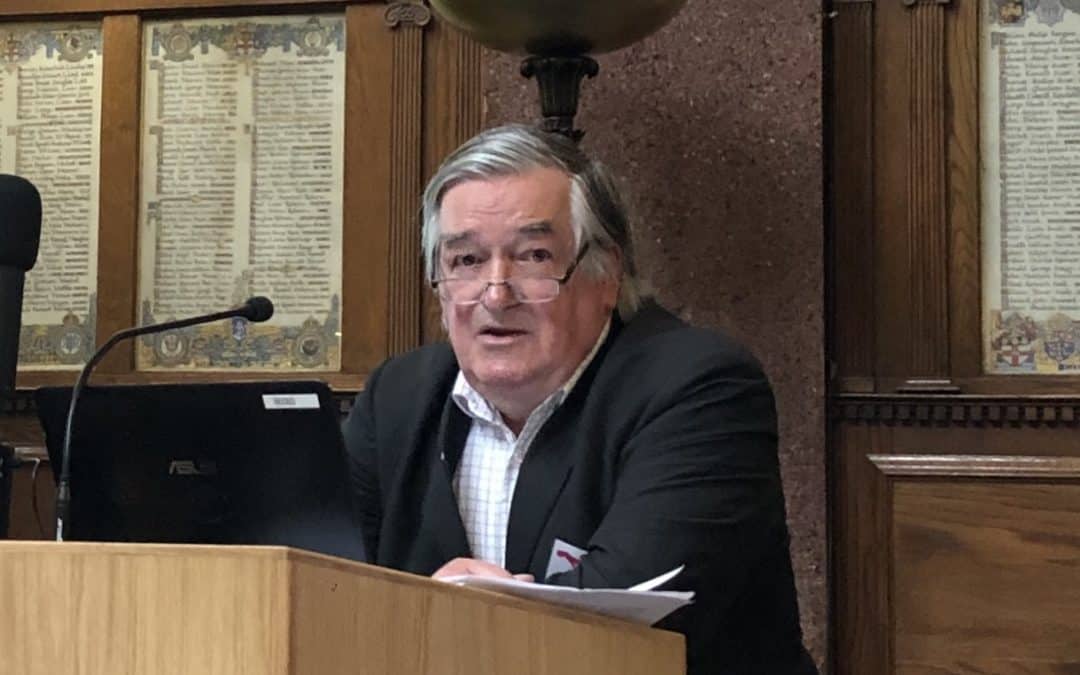
If you have been to family court, there is a good chance that your case was influenced by decisions made by Sir James Munby, who has died aged 77. As a barrister, as a judge, and finally as President of the Family Division – the most senior family judge in the country, sitting in the Court of Appeal – he became one of the most important figures in family law for many decades. Many of his decisions established legal precedent – the principles which bind judges in the lower courts. Many of his decisions protected children and their families against the power of the state; he was in particular a proponent of children’s human rights. In the textbook I authored, the index shows no fewer than 52 pages discussing cases he decided. In part, this is because of his own engagement with academic research and commentary, which he draws on in a number of his decisions, and on the history of law, a subject which evidently fascinated him.
Although he had to retire as President when he reached the age of 70, he did not slow down, continuing to write prolifically, including for the Transparency Project, as one of our supporters and a regular correspondent to the trustees’ inbox. Lucy Reed KC has, on her own blog, Pink Tape, discussed his support for greater public understanding of family law.
A fortnight before his death, he completed a chapter for a book I am putting together. Over several months he and I had exchanged emails and comments about the work, with regular side diversions into memorable cases and other research he was doing (into the “divorce bar” in the early 20th century, where being divorced was so stigmatised that it meant you may not have access to certain jobs). I would send him academic articles that I thought would interest him. The last exchange of emails we had was about forthcoming changes to family law and how we might write about these in 2026. At all times, he was kind, charming, and helpful and his sudden death has been very shocking indeed.
On the Financial Remedies Journal, his friend Sir Nicholas Mostyn has written about Sir James’ contribution to the law on finances on divorce, including several vitally important cases. But it is for child law that I shall remember him particularly. Over the next three months, I shall be teaching my regular course on child law at the University of East Anglia. Such has been his influence on child law that I could rename the course ‘the greatest hits of Sir James Munby’.
In no particular order, here are a few of his greatest hits in the area of child law, and (because I could not leave it out) one important contribution to divorce law reform. Each judgment is marked by considerable knowledge and compassion.
Re B-S (Children) [2013] EWCA Civ 1146
Hot on the heels of a Supreme Court case called Re B, which had held that an adoption order could only be made where nothing else was in the child’s best interests, Re B-S had a seismic effect on social work practice. It emphasised the need for social workers to justify why adoption of a child was better than other options, such as kinship care, rather than assume that adoption was best.
‘This sloppy practice must stop. It is simply unacceptable in a forensic context where the issues are so grave and the stakes, for both child and parent, so high.’
As a result of this case, the number of adoptions fell (the so-called Re B-S effect) and greater use was made of less interventionist orders such as special guardianship.
Re C (Direct Contact Suspension) [2011] EWCA Civ 521 (Fam)
Munby considered the European Convention on Human Rights and the welfare principle in s1 Children Act 1989, holding that contact between parent and child is a fundamental element of family life and is almost always in the interests of the child. The court and thus the judge had a positive obligation to take all necessary steps to maintain or restore contact, and to terminate contact only if it would be detrimental to a child’s welfare.
Re X (A Child) (No 3) [2017] EWHC 2036
X was 17 years old and in secure accommodation. She was seriously mentally ill and had made a number of suicide attempts. She needed hospitalisation, but the issue was locating somewhere that could offer the level of care and supervision that she required as she became an adult and aged out of her current placement. If released, those treating her expected her to kill herself within 24 to 48 hours. Judges have repeatedly expressed their horror at the lack of suitable places for children in X’s position, and Munby’s warning is stark.
‘What this case demonstrates, as if further demonstration is still required of what is a well-known scandal, is the disgraceful and utterly shaming lack of proper provision in this country of the clinical, residential and other support services so desperately needed by the increasing numbers of children and young people afflicted with the same kind of difficulties as X is burdened with. We are, even in these times of austerity, one of the richest countries in the world. Our children and young people are our future. X is part of our future. It is a disgrace to any country with pretensions to civilisation, compassion and, dare one say it, basic human decency, that a judge in 2017 should be faced with the problems thrown up by this case and should have to express himself in such terms.
If, when in eleven days’ time she is released from ZX, we, the system, society, the State, are unable to provide X with the supportive and safe placement she so desperately needs, and if, in consequence, she is enabled to make another attempt on her life, then I can only say, with bleak emphasis: we will have blood on our hands.
My judicial duty, as with every judge in this country, is “to do right to all manner of people after the laws and usages of this realm.” There are occasions, and this is one, where doing “right” includes speaking truth to power. The entrance to the Old Bailey, the Central Criminal Court, admonishes those who enter to “Defend the Children of the Poor.” Is less required of the Family Court or of the Family Division of the High Court? I think not.’
Darlington Borough Council wanted a care order in respect of a boy whose mother was in prison and whose father was a member of the English Defence League, had a caution for statutory rape (as a 17 year old having sex with a 13 year old), and was unwilling to work with social services. In an excoriating judgment, Munby asked just who had made Darlington the arbiter of morality, reiterating that the ‘justification for state intervention is harm to children, not parental immorality’ and law requires a causal link between proven facts and harm or risk of harm to the child. Here, there was no evidence that the child would suffer significant harm – the legal test for a care order – by remaining with his father.
Re Roddy (A Child) (Identification: Restriction on Publication) [2004] 2 FLR 949
A 16 year old girl, who had given birth at 12 to a child who was adopted, wanted to overturn an injunction preventing her being identified, so she could tell her story to the national newspapers. Munby said that
‘Angela may not yet be quite 17 years old but she is a young woman with a mind of her own and, as her solicitor B has said, a mature and articulate young person. We no longer treat our 17-year-old daughters as our Victorian ancestors did, and if we try to do so it is at our—and their—peril. Angela, in my judgment, is of an age, and has sufficient understanding and maturity, to decide for herself whether that which is private, personal and intimate should remain private or whether it should be shared with the whole world. In my judgment (and I wish to emphasise this) it is the responsibility—it is the duty—of the court not merely to recognise but… to defend… the right of the child who has sufficient understanding to make an informed decision, to make his or her own choice.’
Re G (Children) (Religious Upbringing) [2012] EWCA 1233
This case concerned whether Hasidic Jewish children should attend a Hasidic school as their father wanted, or an Orthodox Jewish school as their mother wanted. While these were both very religious schools, the father’s choice led to no recognised secular qualifications. Noting that he was not deciding whose religious faith was better, Munby drew on the work of Herring and Foster to interpret the principle that we do what is best for the children in the case (the welfare principle in s1 Children Act 1989) as being about preserving opportunities and encouraging the Aristotelian notion of living a good life of altruism and virtue. ‘A judge’s job in determining best interests can more accurately be described as maximising the flourishing of the human in question’.
‘Evaluating a child’s best interests involves a welfare appraisal in the widest sense, taking into account, where appropriate, a wide range of ethical, social, moral, religious, cultural, emotional and welfare considerations. Everything that conduces to a child’s welfare and happiness or relates to the child’s development and present and future life as a human being, including the child’s familial, educational and social environment, and the child’s social, cultural, ethnic and religious community, is potentially relevant and has, where appropriate, to be taken into account.’
This case involved a father who had left the enclosed and religious Charedi Jewish community to live as a woman, and who wanted contact with her children. The mother and the community were deeply opposed, and the children might have been ostracised if the contact had gone ahead. The role of the court, said Munby, was to act as the ‘judicial reasonable parent’. Citing his own decision in Re G, and warning the community and the children’s school against any unlawful discrimination, he said that ‘that the reasonable man or woman is receptive to change, broadminded, tolerant, easy-going and slow to condemn.’
R (G) v Nottingham City Council [2008] EWHC 400
The local authority removed a three-hour old baby from the mother’s care. The mother did not actively resist but was very distressed. The local authority, which had no court order, argued that the mother had consented. ‘The idea that this mother in this situation—physically and emotionally weakened and distressed by events—can sensibly be said to have given consent to the removal of her baby verges, in my judgment, on the unreal’, said Munby. In a later case, Lady Hale in the Supreme Court called Munby’s decision ‘absolutely right’. Submission to apparent authority is not consent.
Re B and G (Children) [2015] EWFC 3
Munby was called upon to decide why male circumcision is not significant harm justifying the making of a care order, whereas female genital mutilation – which on a scale at one end is less physically wounding than male circumcision – will always be significant harm. Male circumcision is indeed significant harm, held Munby, but s31 Children Act 1989 says that to make a care order the harm to the child must be attributable to the care of the parents ‘not being what it would be reasonable to expect a parent to give to him’. Male circumcision, said Munby, is in our current culture, reasonable for a parent to provide; female genital mutilation is not. ‘Society and the law, including family law, are prepared to tolerate non-therapeutic male circumcision performed for religious or even for purely cultural or conventional reasons, while no longer being willing to tolerate FGM in any of its forms.’
Owens v Owens [2017] EWCA Civ 182
When Mrs Owens applied for a divorce, she would scarcely have expected that her divorce would be refused on the basis that her husband had not behaved in such a way that it would be unreasonable to expect her to continue with him. This decision was upheld, firstly by the Court of Appeal and then by the Supreme Court. Munby’s judgment in the Court of Appeal upholds the decision but makes it clear that he thinks the time has come for reform: ‘Parliament has decreed that it is not a ground for divorce that you find yourself in a wretchedly unhappy marriage, though some people may say it should be. Such is the law which it is our duty to apply.’ Citing the poet Philip Larkin, who infamously wrote that “Sexual intercourse began / In nineteen sixty-three”, he went on to discuss how much society has changed since the divorce law he had to apply was passed , and calls it hypocritical and intellectually dishonest. The public shock at Owens, which was that a system we had taken as divorce on demand was not that at all, resulted in the passing of the Divorce, Dissolution and Separation Act 2020.
A series of cases from Re A through to Re Z and then from AA through to Re AJ
In each of these cases, failures by fertility clinics to record consent to be a father or second female parent meant that those who had sought fertility treatment with the mother had not become legal parents. Munby painstakingly undid the messes and established parentage. The allocation of parentage is, he said, ‘a question of most fundamental gravity and importance. What, after all, to any child, to any parent, never mind to future generations and, indeed, to society at large, can be more important, emotionally, psychologically, socially and legally, than the answer to the question: who is my parent? Is this my child?’
Image: photograph of Sir James Munby by Paul Magrath, June 2019
Polly, thank you for writing this.
Like you, I was in contact with James in December about a book I have begun to write and, after his enthusiastic and helpful replies, and now the terrible shock, sadness and sense of loss at his death, I really will have to complete it, thinking of him as I do.