
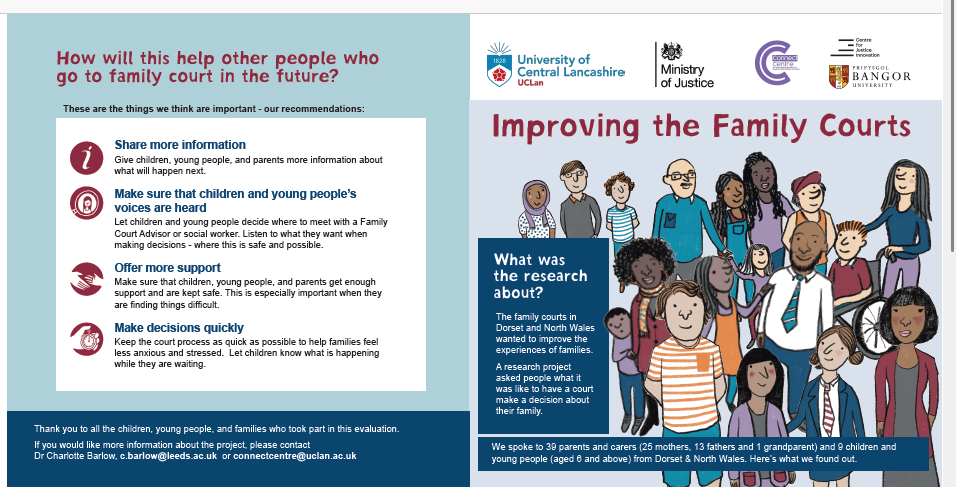
The evaluation of children and families’ experiences in the first stage of the Pathfinder Pilot was published this week by the Ministry of Justice, ‘Understanding the experience of children and families’. This research covers interviews during August – December 2024 with families who’d been in private law proceedings under the pilot in Dorset and North Wales. The pilot began there in February 2022. It’s now being gradually rolled out to other court areas. A total of 25 mothers, 13 fathers, one grandparent carer, and nine children were interviewed for this report. The children were aged from six upwards, average age 12. The cases had finished at least three months before the interviews took place.
We don’t know why these interviews took more than a year to process, especially as there are nine named authors of the report, as many authors as there were children interviewed.
An earlier evaluation published in March 2025, which was on value for money, was generally positive about the courts’ and agencies’ views of the Pathfinder. We wrote about that report here. We’ve also written about the very positive views of the Judiciary and the Domestic Abuse Commissioner. These largely describe the drop in length of proceedings, which of course should create less anxiety and uncertainty for families, as well as save on resources.
The aims of the Pathfinder include keeping the court’s focus on the child from the outset, which involves the Family Court Adviser (FCA) meeting the child early and submitting a Child Impact Report (CIR) about the child’s welfare, rather than being asked to report on their welfare after the parents have submitted statements setting out their own case and evidence. Another important aspect of the model is improving the court process for victims of abuse.
The authors of the new evaluation report have made a helpful infographic (part of which is shown in the screenshot above) which sets out some of their main findings. It’s mainly about the children’s views and there’s no reference in it to the issues about domestic abuse that take up much of the report itself (see ‘Challenges’ below). We understand that the infographic was co-designed with the young people interviewed, so it is about the messages they wanted to send.
The report itself summarises the benefits of the Pathfinder model as:
- Positive interactions with most professionals, particularly the Cafcass/Cafcass Cymru FCAs
- Inclusion of domestic abuse services (viewed positively by some mothers interviewed)
- Children generally felt comfortable speaking with Cafcass and social workers. The CIR was a valuable opportunity to express their feelings about contact arrangements
- Parents felt well informed about Pathfinder early in the process.
- Reduced length of the court process – parents who had previously been to court felt that Pathfinder was more efficient than the traditional model.
The challenges were:
- Some children and parents reported negative interactions with professionals, particularly local authority social workers and some judges. Parents with domestic abuse in their case had mostly negative experiences with judges.
- Some parents reported not feeling believed by professionals, having their allegations of domestic abuse downplayed and a lack of understanding of the trauma experienced by victims
- Children’s participation varied. Their wishes were not always reflected in the CIR or in case outcomes, and the reasons for this were often not explained to them.
- Inter-agency working needed improvement; parents suggested that safeguarding or welfare concerns were often downplayed or ignored by the professionals.
- The Review stage was rarely implemented.
This Review stage had been discussed in quite some detail in the March 2025 evaluation as being inconsistently applied and was removed from the Pathfinder rules in December 2024. A footnote on p 1 of the report mentions this, although because the Review stage was meant to be in place for the families involved, it keeps being mentioned through the report.
While what the report terms ‘challenges’ looks disappointing, we think it’s important to remember than these were identified by quite small numbers of parents in the two courts, especially in Dorset. It may be that the parents who agreed to take part in the research had had a more negative experience than average. It’s not possible to say whether such a small sample of views is representative of the many families who were involved with the Pathfinder route, as the authors concede.
Some highlights of interest
- Participants with solicitors had a more positive experience than litigants in person
- There were concerns about the handling of allegations of ‘alienating behaviours’
- The authors said:
To reduce re-traumatisation, future rollout and existing pilot sites should focus on key improvements. These include thoroughly investigating domestic abuse when it is raised (including counter allegations) and understanding its dynamics in court proceedings. Improving collaboration among agencies to support families is crucial and could be achieved through joint training that emphasises trauma-informed approaches and gendered understandings of domestic abuse.
- Children and mothers generally described more positive interactions with FCAs than fathers did. Some fathers felt their contact with the agency had been minimal or poor and believed FCAs were biased towards mothers, overlooking their perspectives
- Participants had mixed experiences with judges. Many mothers felt judges were dismissive of their experiences, and some believed that the judge had not read the written evidence in their cases. Those who experienced domestic abuse generally spoke poorly about their interactions with judges; fathers’ views on the fairness of judges varied.
- Mothers who had been referred to domestic abuse services were generally positive about this but there were some problems from a lack of capacity, especially in North Wales where both parents might want to use the same service, but the mother was often already receiving support.
- Parents weren’t always clear whether a DASH (Domestic Abuse, Stalking and Honour-based violence) risk assessment had been carried out.
- Some mothers described court proceedings as ‘retraumatising’ but fathers tended to describe them as ‘stressful’
- Parents generally felt that decisions about interviewing their children had been taken sensitively, especially where children had special needs
- Schools were the preferred venue for interviews although some children were not offered a choice.
- Some children became anxious because the interviews left them wondering what would happen, and they did not always hear anything further from Cafcass.
- Parents were pleased their children were given the opportunity to speak to the FCA and express their views, but a number of parents and children were upset that these views didn’t seem to be acted on. The report suggests that where the outcome does not accord with the child’s expressed wishes, the reasons for this are appropriately explained.
- Parents who had been to court previously thought the CIR was a better method than the traditional process, but some parents didn’t recall the CIR or said they hadn’t had a chance to comment on it.
- Some mothers described instances of abuse and violence against children being ignored by Cafcass/Cafcass Cymru, local authorities, and/or judges. This might have been omissions in the CIR or seeming to be ignored because no action was taken.
- As mentioned above, there was some confusion about the Review stage but virtually none of these parents did have a review and some said they thought one was needed. The authors seem inconclusive on the value of a review, even though this was dropped a year ago.
Conclusion
Although some of the children interviewed didn’t feel the early meeting with a FCA and the production of the CIR had been a productive experience, the evaluation report states that children’s participation is one area where the Pathfinder is working well. The major issues the report raises are about the courts’ handling of domestic abuse and some inconsistency in agencies making a DASH referral or following up safe guarding concerns. The report makes some strong recommendations for improved training for judges and all professionals on avoiding retraumatisation. However, the adults interviewed who’d been through similar court applications before the Pilot came in – which was a quarter of the total – did suggest there’d been an improvement.
We don’t know if there will be a Government response to the report’s recommendations. Also yesterday, the Minister stated on social media that the Pathfinder was being extended to Hampshire and that this would: ‘shield more children from trauma; give children and victims greater support; and provide swifter justice for families’. It would appear from the evaluation that this might depend on investment in training and developing services.
We have a small favour to ask!
TEN YEARS A CHARITY
The Transparency Project is a registered charity in England and Wales run by volunteers who mostly also have full-time jobs. Although we’ve now been going for a decade, we’re always working to secure extra funding so that we can keep making family justice clearer for all who use the court and work in it.
We can’t do what we do without help from you!
We’d be really grateful if you were able to help us by making a small one-off (or regular!) donation through our Just Giving page
What is the main purpose of the Transparency project and is it concerned with the forced adoption issues in family law?
Our charitable objectives are set out here: https://transparencyproject.org.uk/constitution/
We do sometimes write about forced (non-consensual) adoption.