
A new policy paper was published by the Ministry of Justice on 28 October: ‘Child Focused Courts Target Operating Model’.
The Child Focused Courts (CFC) model is being introduced a few court areas at a time. It’s expected to have completely replaced the traditional process in private law cases by the time new applications for section 8 orders are being made at the end of March 2029. So, both systems will be operating in some places for the next two and a half years. CFCs currently operate in all of Wales and in several court areas in England; during November, it’s being introduced in eight court areas in the north and midlands of England.
It’s not all that easy to find out whether your local court in England already follows the CFC model, but there’s a list in this delivery update document, also published in October – for some reason not on the same web page as the policy paper.
The new policy paper emphasises that the target of the CFC model is now ‘One report, one hearing’.
In this blog post we’ll highlight the main changes we can expect to see as the courts gradually move on to the new model, and we ask some questions.
Aim of the policy paper
The paper is ‘intended to establish a shared understanding of the system-wide ambition and aspiration for the future of private law proceedings, via Child Focused Courts’.
It’s explained that the process is governed by Practice Direction 36Z in the Family Procedure Rules and incorporates Practice Direction 12B (Pilot). The Rules are still calling this a ‘pilot’. PD36Z is titled ‘Pilot scheme: Private law reform: Investigative approach’ and para 1(3) says the pilots are in place until March 2027.
The paper says that people across the family justice system have welcomed a range of recent reports that call for reform and are committed to change that:
- Moves away from an adversarial system to an investigative and problem-solving approach that promotes safety from harm.
- Improves the response to children and parents who have experienced domestic abuse, including the impact of coercive control and trauma.
- Centres and amplifies the voice of the child through meaningful and safe engagement and participation in proceedings.
- Promotes collaborative multi-agency working, with a shared focus on finding safe and sustainable solutions to improve children’s welfare and outcomes.
The new process
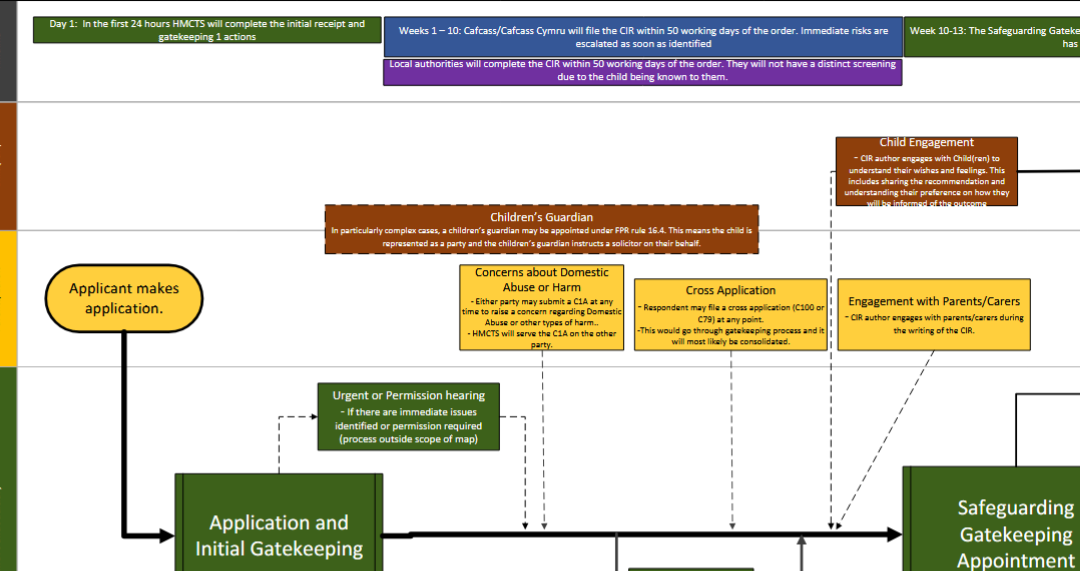
There’s a flow chart illustrating the new process. It’s too large for us to reproduce on the page in full, but there’s a screen shot of part of it in our image at the top of this post and it’s downloadable here. The flow chart specifies timelines that are not detailed in the paper.
When the application for a section 8 Children Act 1989 order is received, there’s initial gatekeeping by the court to identify key issues and which social work agency (Cafcass, Cafcass Cymru or a local authority) should complete the Child Impact Report (CIR).
Under the Rules, we can see that this initial gatekeeping is by a legal adviser to the magistrates or by a district judge.
It’s anticipated that 85% of children subject to applications will meet an appropriate social worker near the outset of the case who then writes the CIR. Under the previous system, about 30% of children were being seen by a social worker, and only if and after a s 7 report had been ordered.
If the CIR identifies issues of domestic abuse, support can be offered from an IDVA (independent domestic abuse adviser).
The paper explains:
In line with a ‘one report, one hearing’ approach, the Child Focused Model replaces the Safeguarding Letter/Safeguarding Enquiries Report and Section 7 Report with a comprehensive CIR prepared early in the process. This frontloads the information gathering and gives the court a full picture much earlier in the progression of the case. The CIR combines safeguarding checks, risk assessments (which may include a DASH risk assessment* when domestic abuse is raised as an issue in the case), the child’s wishes, feelings and circumstances, and the parents’ or carers’ views on the recommendations into a single report.
* Domestic Abuse, Stalking, and Honour-Based Abuse risk assessment tool
The target date for a CIR to be submitted to court is less than 50 days. We assume that’s 50 working days (about eight weeks which is the current expectation in CFC areas) but the accompanying flowchart says eight-ten weeks for the CIR.
Although the paper says there won’t be a FHDR (dispute resolution hearing) anymore and the aim is for only one hearing, it mentions a Safeguarding Gatekeeping Appointment. It seems that parties don’t attend this, but case management decisions are made at this point. A final decision can also be made at the Appointment.
A Decision Hearing may have to be held, unless the case can be resolved without a judge having to make what’s called a ‘determination’ i.e. a decision about what is still in dispute.
The target is for 80% of applications to conclude within 26 weeks of being received.
Comment
Although research and evaluation of the pilots have been limited, there seems to be a consensus that the court taking a problem-solving approach, and children meeting the social worker before parties get into an exchange of statements and evidence, can potentially lead to improved outcomes. As well as it being in a child’s welfare to avoid delay in resolving the dispute, speeding up cases is saving resources in this era of austerity justice. Early involvement of support services where there are allegations or concerns about domestic abuse has also been described as an improvement.
However, we have a few questions about the way the model will in reality be implemented.
- One hearing
The paper says:
The Child Focused Model aims to support agreement between parties where possible, and where judicial determination is required, to ensure the court has the information needed to make a safe and welfare focused decision, often without the need for more than one hearing.
It’s estimated that between 60 and 90% of section 8 applications feature allegations or suspicions of domestic abuse. There are already concerns about the CFC model discouraging fact-finding hearings, as expressed by Cafcass and Rights of Women in Re C (Child Arrangements Orders; Domestic Abuse; Child Focused Court) [2026] EWCA Civ 1216. It was confirmed by the President in that case that the CFC has not changed the law on the necessity for fact finding hearings, but the policy paper says:
additional hearings should be listed by exception, for example in following the urgent case process, or where there is a requirement for a Fact-Finding Hearing, or contested applications for permanent removal from the jurisdiction.
Is it realistic to base the system on fact-finding hearings being exceptional, if most of the cases that can’t be resolved feature domestic abuse?
2. Domestic use support services
Related to 1, above, there‘s an assumption that a victim/complainant will automatically be referred to an IDVA or other domestic abuse support service – but are there enough IDVAs and specialist support services available in every court area?
3. Out of court resolution
Although the policy paper refers to partners in the family justice system, and to resolving cases early, without a judge, there’s no reference at all to mediation or other out-of-court alternative dispute resolution services in this paper. We wonder why there is a great deal of detail in PD 36Z about the necessity for a MIAM and the obligation on the court to refer to out-of-court services where appropriate etc and yet mediation services ares entirely ignored here. This doesn’t match well with the change quoted above:
Promotes collaborative multi-agency working, with a shared focus on finding safe and sustainable solutions to improve children’s welfare and outcomes.
4. What exactly is a Safeguarding Gatekeeping Appointment?
The new policy mentions these here:
If the court considers it appropriate, a case could be concluded by the making of a final order at the Safeguarding Gatekeeping Appointment, without an attended hearing. This could occur because the frontloaded information gathering and assessment stage has resulted in a holistic CIR which provides the court with the information and recommendations required to make an appropriate and safe order (decision), particularly if the parties consent to an order being made. Where the court makes a decision without an attended hearing, the parties have the right to ask the court to reconsider the decision, usually within seven days of the order being served.
But if no one attends the ‘Appointment’ and there isn’t consent, will parties be clearly informed on what they need to do?
We’ve looked at the current rules and these do include a stage called Safeguarding Gatekeeping Appointment/Case Management. This is an internal stage in the process undertaken by the allocated judge i.e. neither the parties, their lawyers, nor the CIR author attends.
The noticeable difference between the Rules and Practice Direction and the new policy is that there doesn’t seem to be any reference in the ‘pilot’ Rules to a final decision being made at the Appointment or a seven-day time limit on a party objecting to a decision made at the Appointment. A general rule about objecting to a case management decision within seven days can be found in Rule 4(3)(6) – a separate part of the FPR.
Is the word ‘appointment’, if no one except the judge actually has an appointment, accurate for a desk-based exercise that lawyers would normally call ‘a decision made on the papers’?
Rather than ‘One report, one hearing’, this looks like ‘One report, no hearing’.
5. The timeline
There seems to be a disconnect between the CIR being filed in week 8-10, but the cases not generally expected to complete in less than 26 weeks i.e. six months. This suggests that few cases will in fact be completed at the Safeguarding Gatekeeping stage. You have to look at the flowchart to understand the timescales that aren’t detailed in the paper itself. The Appointment is to be held in weeks 10-13 and the Decision Hearing in weeks 13-15. It’s not clear where the 26 weeks come from – but perhaps the 15 weeks for a decision is aspirational.
6. Is the CFC still ‘a pilot’?
It seems the answer to that is: ‘No’. The policy paper differentiates between the Pathfinder Pilot which began in two court areas in 2022 and the CFC model to which the government is now committed. The name change was announced alongside the commitment by David Lammy (then Lord Chancellor) in March this year.
The standard Family Procedure Rules are however still based on the traditional model, called the Child Arrangements Programme (CAP). The procedures for the CAP are set out in Practice Direction 12B. However, there is a Practice Direction 12B (Pilot) that is attached to Practice Direction 36Z. It’s a bit confusing that 12B is placed after 12A but 12B (Pilot) is found placed after 36Z.
Cafcass Cymru webpages still describe the private law process as the Pathfinder Pilot; we can’t see anything there on the Child Focused Court. There’s a brief explanation on the Cafcass England site of the evolution of the Pathfinder to the CFC, and the roll-out. Their website says that the process will be explained individually to parents affected.
According to the most recently published Family Procedure Rule Committee minutes, 5 October, an update would be added to the Rules on 17 November. The minutes still call the scheme a pilot, however and, as at 24 November, we can’t see the update on the FPR page.
The purpose of a pilot is to trial experimentally a proposed policy change. That change has already been confirmed, so wouldn’t it be clearer to drop the term ‘pilot’ from the Rules?
7. Transparency
We note that the paper says that judges have been undertaking targeted work to address the longest running cases and reduce the backlog of private law work to create the conditions for successful implementation of the Child Focused Model, amidst ‘other priorities for the judiciary which include transparency in the family courts and the commitment to wider cultural change in relation to the family courts’ response to domestic abuse’.
However, we can’t see any indications of progress with transparency leaping off the page. Does the CIR author sit down with each parent to discuss the report with them? Or is the report simply served on each parent by the court? Many parents don’t have a lawyer to advise them on all this.
If the child is old enough to see the report, how is this dealt with? How does the judge know whether the child has participated in any feedback on the report?
Are parents and (older) children clearly advised by the court what to do if they think something in the CIR is wrong? The flowchart says that the CIR author will share their recommendation with the child before the Appointment, but doesn’t say they will talk to the parents about it, or whether they will tell the court and the parents how the child responded.
Although few private law judgments are currently published and few are attended by reporters, even that level of transparency and accountability is being discouraged, if decisions are being made at the Appointment, which a reporter can’t attend, or even know about, because it hasn’t been listed as a hearing. Are the parties told when it’s to take place?
However beneficial the new model may be for families, we hope that the court and/or Cafcass are providing clear guides to them, because reading the policy paper alongside the Rules isn’t clear at all.
We have a small favour to ask!
TEN YEARS A CHARITY
The Transparency Project is a registered charity in England and Wales run by volunteers who mostly also have full-time jobs. Although we’ve now been going for a decade, we’re always working to secure extra funding so that we can keep making family justice clearer for all who use the court and work in it.
We can’t do what we do without help from you!
We’d be really grateful if you were able to help us by making a small one-off (or regular!) donation through our Just Giving page