
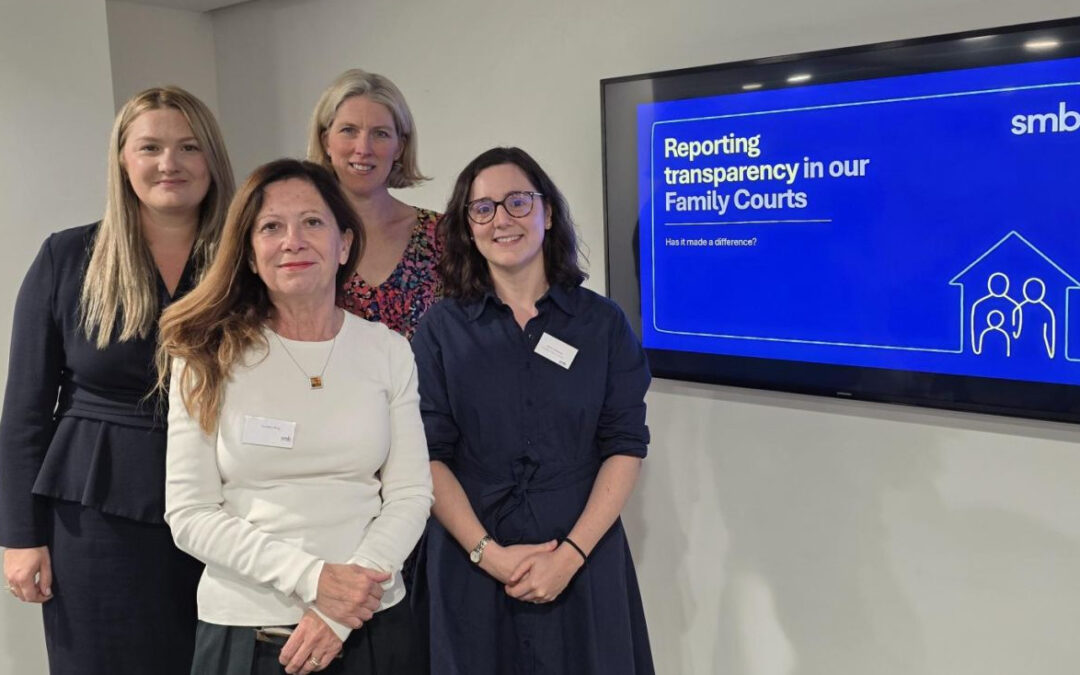
Last week the law firm Simons Muirhead & Burton (SMB) hosted a panel discussion at their London office on Reporting Transparency in our Family Courts: Has it made a difference?
The panel was chaired by Tessa Bray, a partner at SMB, who explained that in January 2025 the Family Procedure Rules had been changed to enable family courts to make Transparency Orders, allowing anonymised reporting on proceedings involving children by accredited journalists and legal bloggers. The purpose of this evening’s panel was to discuss what effect that was now having.
Sanchia Berg, former BBC reporter, now freelance, began by recalling the previous position, established by an earlier change in the rules in 2009, which had first allowed accredited journalists to attend private family court hearings, but had given them no right to report anything. They had to apply for permission each time. Under the new Transparency Order regime introduced in 2025, reporters were now allowed to report cases on an anonymised basis by default, unless and to the extent that the court ordered otherwise. That marked a significant change.
Following the change, she had attended family courts in Leeds for three weeks, in the hope of finding cases to report for the BBC. There were still obstacles to reporting, not least the uninformative way cases were listed, usually anonymously, but also giving no indication of the subject matter. Reporters still relied on information from other sources, often litigants themselves, in deciding which hearings to attend.
She recalled some of the other significant family court cases she had covered for the BBC over the years, including the Finley Boden case, in which family court magistrates had given a baby back to the parents who were eventually jailed for killing him; and that involving an abandoned baby, named Elsa, who turned out to be one of three siblings, identified by DNA testing, all of whom had been similarly abandoned. The public interest in such cases justified reporting the family courts, and there was more to media coverage than celebrity divorces.
Claire Overman, a barrister at Doughty Street Chambers who specialises in media cases, explained some of the nuts and bolts of the new regime. The change in the Family Procedure Rules in January 2025 had followed a two-year pilot scheme in a number of individual courts. This had enabled the courts to test the process whereby reporters (including ‘duly authorised lawyers’ generally referred to as ‘legal bloggers’) were able as of right to attend and report the substance of a case, anonymously, and to have access to documents such as skeleton arguments and court orders. It also allowed parties to speak to reporters. The Transparency Order template allowed restrictions to be varied, but if the conditions were too restrictive it would have the effect of shutting down any reporting. In such cases, reporters or publishers might need to apply to the court to vary or appeal against such restrictions.
Helen Pomeroy, a barrister at 1 King’s Bench Walk who specialises in family law, said the debate over transparency had not died down. She cited the recent essay by the late Sir James Munby, former President of the Family Division, The Astonishing Fate of Scott v Scott (1911-1913), which discussed the foundational case on open justice, the notion (which he rejected) of the family courts as a jurisdictional ‘desert island’, and the long running debate over the secrecy of financial remedy proceedings — which was also the subject of an upcoming hearing in the Court of Appeal.
But as a practitioner, she was aware of concerns among many members of the family bar about the practical aspect of transparency. The number of hearings attended by journalists was in practice very small, but it could cause disruption, particularly if the reporter was a legal blogger who might not be familiar with the rules. Reporters often did not provide sufficient notice for the court to anticipate their presence, and the process of considering and drafting the Transparency Order could be time consuming, particularly if there were several different parties all of whom needed to take instruction and voice any objections they might have. This could take up valuable hearing time, sometimes half a day, on a matter that essentially contributed nothing to the outcome. If permitted, the additional scrutiny of the press and the possibility of their stories getting ‘out there’, could be alarming and stressful for some litigants.
Another possible consequence of the increase in transparency in the family courts was that parties were more inclined to opt out of court altogether, and go for alternative dispute resolution (ADR) or other forms of non-court dispute resolution (NCDR). There was no point in the courts being transparent, if parties ended up not using them.
Discussion
These contributions were, I felt, well chosen in terms of presenting the issue in the round. We were able to see the practice of transparency from the point of view of those doing the reporting, and representing the public interest, as well as publishers and the media generally, and also from the point of view of family practitioners for whom the scrutiny was a potential source of friction.
But what about their clients? What about the litigants? Obviously there were some, as Helen had pointed out, for whom the scrutiny was an added source of stress, on top of that already flowing from the proceedings. But there were others, as Sanchia made clear, who wanted the scrutiny because they were fearful about the fairness of the proceedings. And even where they might fear the exposure, the fact that it was anonymous must laregly neutralise its impact, as compared with the far more traumatic process of the adversarial hearing itself.
There were a number of questions and contributions from the audience, including reporters, practitioners and advisers. It was pointed out that reporters routinely cover cases involving children in the criminal courts, anonymously, and were familiar with the reporting restrictions that applied.
I pointed out that, as a legal blogger, properly so described, I was well aware of the legal restrictions on reporting the family courts, that under the current regime there was no requirement to give notice but that I always tried to do so, and that in my experience the process of agreeing the transparency order was generally uncontroversial and relatively swift.
The current transparency regime should be seen not in isolation but as part of a wider reinforcement or restoration of open justice that was now being undertaken by the Transparency and Open Justice Board established by the Lady Chief Justice and chaired by Nicklin J.
There is also a good summary of the discussion from another attendee, Beth McLoughlin via LinkedIn.
Photo credit: Simons Muirhead and Burton. Panellists L to R: Pomeroy, Berg, Bray, Overman.